
100 - Performance
A journey through 'my' films.

Of course, they’re not ‘my’ films. However, whether I could watch them every day or would happily never see them again, these 100 films have had a marked impact on my life, my love of film, all manner of things, really.
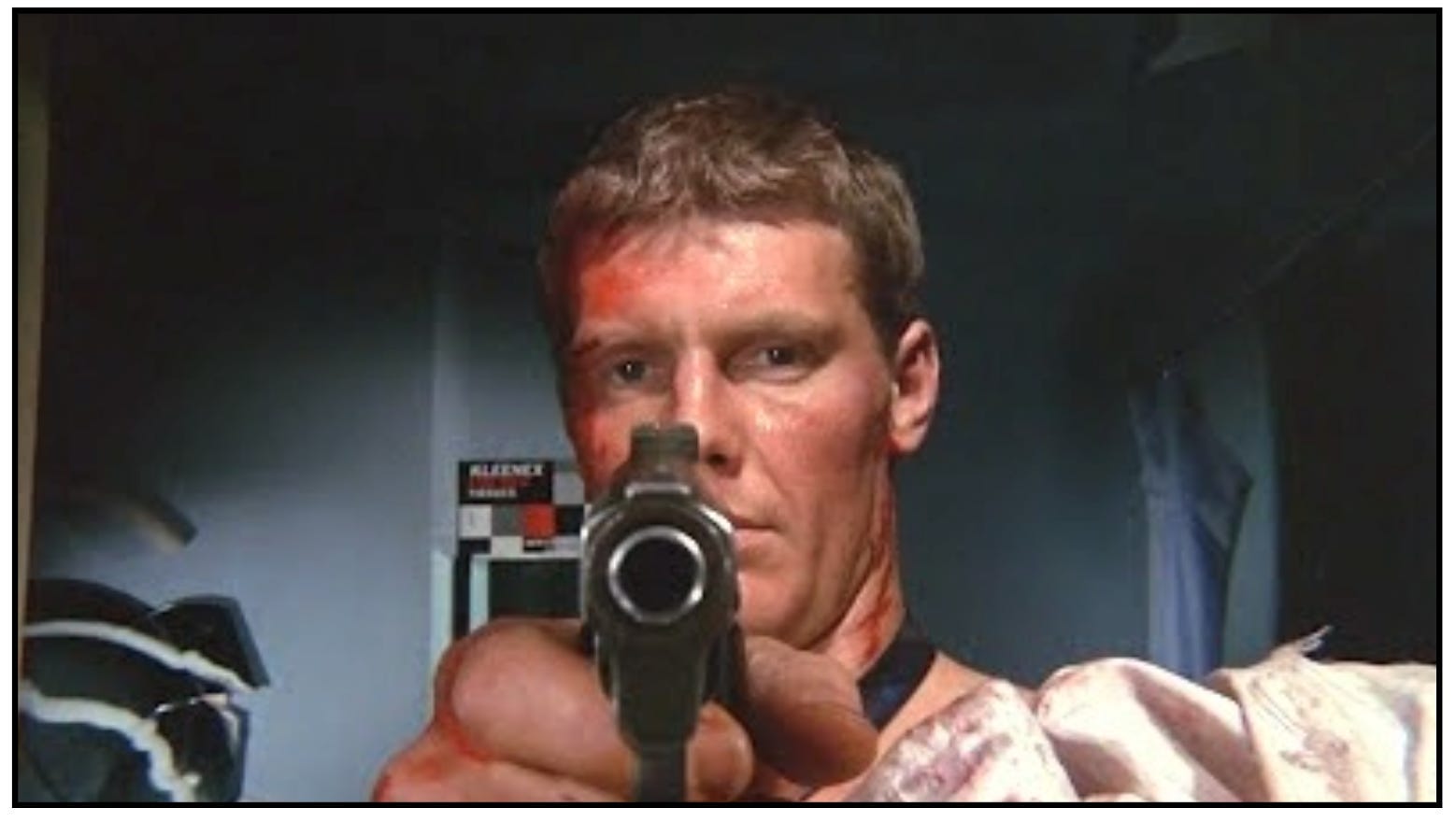
Performance (1970)
If you weren’t around when it was released, the chances are your first exposure to Performance was through either Big Audio Dynamite’s ‘‘E=MC2’,‘ or Happy Monday’s ‘Mad Cyril’, hit singles each of which feature dialogue sampled from the film (“I don’t think I’m going to let you stay in the film business”; ‘“It was Mad Cyril!”) .
Failing that, if you’re British, you might have been lucky enough to catch it on Moviedrome, the BBC’s Sunday night movie strand hosted by Alex Cox (Repo Man, Sid And Nancy). In his introduction to the film, Cox made Performance sound every bit as exotic and brain-bending as the Mondays and BAD. But then, when the movie began, it became immediately apparent that speech and song had ill-prepared me for how extraordinary Performance truly was.
Commencing with the launch of a rocket, Performance’s envelope-pushing made the previous year’s Apollo moon mission seem like a walk into town. And while his fellow rock star David Bowie was busy singing about Major Tom, Mick Jagger transformed from Rolling Stone into astronaut, his mission to take the human mind to places beyond the reach of all but the most potent hallucinogens.
If this sounds like overstatement, it’s important to point out the roles environment and experience play in one’s appreciation of Performance. For example, if you were raised in a “Bohemian atmosphere” similar to that of the film’s protagonists, the events depicted might not seem that remarkable. But if you were brought up in a leafy suburb on a diet of Elkie Brooks and Abba, the world brought to life by Nicolas Roeg and Donald Cammell seemed utterly fascinating. Gangsters, rock stars, ultra-violence - Performance was a vehicle for the verboten. And while you didn’t have to agree with the film’s suggestion that psychedelic drugs and androgynous sex might be the avenue to the better life, you couldn’t deny that it was an intriguing message.
A taboo-lacerating work, Performance was made more beguiling still by its back-story. A film that so disturbed leading man James Fox he quit the industry for a decade, Roeg and Cammell’s film also sowed the seeds of discontent between the Rolling Stones. The on-set presence of real-life “chaps” such as David Litvinoff also leant the picture an authenticity completely at odds with the cock’er’nee swagger of, say, The Italian Job. Indeed, no British gangster film has come close to Performance for atmosphere.
When American execs saw the film, they talked of a pervading air of menace. Repulsed, they shelved the picture for two years, a release only being secured after Cammell and Jagger petitioned the studio. But as much as polite society tried to restrain Performance, this ultimate celebration of excess refused to be bound. And 55 years later, it continues to attract film fans with its sinisterly beguiling glow.
Performance seems all the more extraordinary when you consider that it was its directors’ debut film. An acclaimed cinematographer (Fahrenheit 451, The Masque Of The Red Death, Far From The Madding Crowd, ), Nicolas Roeg had long been waiting for a chance to helm a picture when he found himself collaborating with the Edinburgh-born Donald Cammell. An impossibly exotic figure, Cammell was heir to the Cammell-Laird shipping fortune whose father, Charles, had written a biography of arch-diabolist Aleister Crowley. A society painter before he turned to moving pictures, Cammell was a hedonist whose interests included threesomes and dating very young girls. He was also a friend of the rich and famous who counted Mick Jagger and Marlon Brando among his best buds.
One of the questions often asked about Performance is who actually directed the film? Since Roeg has such an impressive CV (Walkabout, The Man Who Fell To Earth, Bad Timing, Insignificance, Eureka), the tendency is to grant him the lion’s share of the credit. But while Cammell’s CV is far sparser (he completed only three other films - Demon Seed, the massively underrated White Of The Eye and Wild Side), leading man Mick Jagger’s in no doubt who the real brains behind the bacchanalia was. “Nic Roeg wasn’t the director of Performance,” explained the Rolling Stone in interviews, “certainly not in the way that you and I think of it. Certainly not of the acting.”
Jagger’s involvement was crucial to the coming together and completion of Performance. Indeed, if one of your leading characters is a retired singer with criminal tendencies, who’s better qualified to play the role than the biggest rock star of the planet who only the year before had been arrested for cannabis possession. In addition to bringing bankability to the project, Jagger also lent Performance an intriguing subtext. At the very moment Mick agreed to play Turner, a pop performer who has said goodbye to fame in order to screw and drug his way into obscurity, Stones guitarist Brian Jones was following a very similar course of action.
Crippled by his addictions, Jones rapidly went from rock guitarist to recluse, a transformation that’s touched upon in the motion picture Stoned. However, if you can’t be bothered to check out Stephen Woolley’s biopic, Jagger’s work in Performance will give you a good idea of the torment Jones was going through as well as the effect it had on his bandmates.
And while the Stones imploded, James Fox was getting to know some very interesting people. Johnny Shannon was an old school ‘character’ and boxing second who’d been in Henry Cooper’s corner when he flattened Cassius Clay. Through Shannon, Fox, until then almost exclusively known for playing foppish types, learnt how to dress and talk like a ‘chap’. He also began to box, becoming so good that Shannon let him have a pop at one of his pupils: “Jimmy loved it. He caught the other bloke on the nose and when the blood started to flow, you saw Jimmy’s eyes light up.”
Fox’s transformation into East End tough was completed through consultations with David Litvinoff and John Bindon. Litvinoff came on like a hybrid of London’s most infamous ‘identities’, Ronnie and Reggie Kray. Homosexual, violent but with incredible connections, Litvinoff illustrated how the underbelly had become a part of everyday society. As such, he was the perfect person to teach the aristocratic Fox how to enjoy a “bit of a cavort”.
But still things weren’t heady enough for Cammell. So he threw his girlfriend Michelle Breton - a French model with a thing for troiism - into the mix. And he cast his advisers Bindon and Shannon, the latter landing the key part of gay gang boss Harry Flowers. At last, the madhouse was open for business. And once Cammell and Roeg were done filming, James Fox was only fit for asylum living.
The 10 years Fox spent away from movies, doing good works for the Navigators Christian charity, is often seized upon as an example of Performance’s wretched excess. The actor himself admits that his mind was blown long before he made the movie. But there were those who walked away from the movie badly wounded: Michelle Breton returned to France and lapsed into heroin addiction, and drugs also played a destructive role in Anita Pallenberg’s life
Those who talk about the ‘curse of Performance’ seem to base their superstitious nonsense less on the film’s fallout than on the troubling nature of the picture. The truth of the matter is, no one walks away from Performance unscathed - that’s what makes it so special. In an age where people talk about going to the multiplex to ‘veg out’, Cammell and Roeg demand a lot of their audience, and take a large chunk of its innocence into the bargain.
In the final balance, there’s no doubt that we the viewer come out of this deal best. Exhilarating and intoxicating, suffocating and annihilating - if Performance was a drug, its street value would be astronomical. It’s as Jagger’s revitalised Turner explains, “The only performance that makes it, that makes it all the way, is the one that achieves madness.”