
100 - Citizen Kane
A journey through 'my' films.

Of course, they’re not ‘my’ films. However, whether I could watch them every day or would happily never see them again, these 100 films have had a marked impact on my life, my love of film, all manner of things, really.
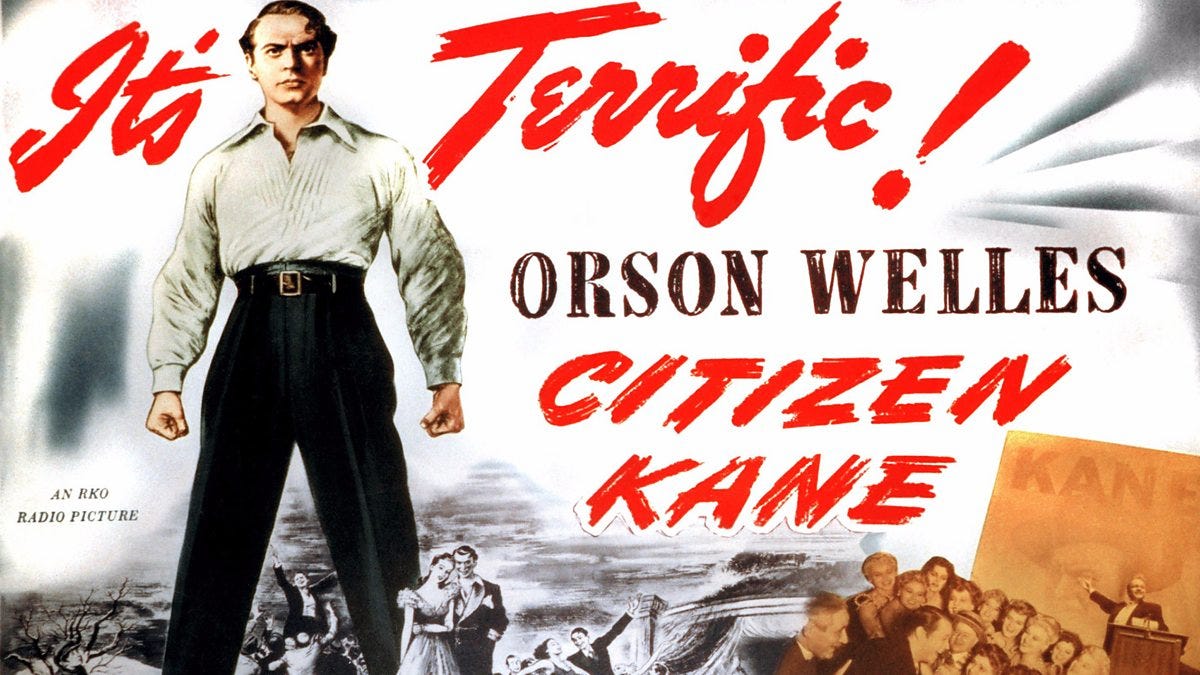
Citizen Kane (1941)
Every few years it becomes fashionable to take a hammer to Citizen Kane. No matter that Orson Welles’ opus is the AFI’s favourite movie, has often topped the BFI’s film survey, and is revered by directors as diverse as Ken Russell and Steven Spielberg, once in a while, someone comes along and rocks the boat.
Screenwriting guru Robert McKee took great in savaging Kane throughout the 1990s, dismissing it as boring and showy. Even revered critic Paul Kael couldn’t resist taking a pop at the picture, using her introduction to the published script to ‘prove’ that Welles didn’t actually write Citizen Kane.
As Kael’s thesis is flawed (there’s ample evidence that Welles wrote - at the very least - three key sequences), it also illustrates why all attempts to raze Kane are doomed to fail. For so what if Welles hadn’t written the script? He still directed, produced, cast and starred in Kane. He also went through a world of hurt to get the film made (co-writer Herman Mankiewicz was very talented but also often half-cut; Welles broke his ankle and wrist mid-shoot) and then had to weather a shit-storm when the picture’s loose inspiration, press baron William Randolph Hearst, tried to scupper the film’s theatrical release. All this before George Orson Welles turned 26.
“He’s ‘The Man’ and I still think that underrates him” - Jack Nicholson’s take on Stanley Kubrick equally applies to Citizen Kane; calling it the greatest move ever made somehow feels insufficient. Perhaps it’s the superficial simplicity of the storyline that encourages understatement - a reporter (William Alland) sets out to discover the meaning behind “Rosebud”, the last word spoken by press mogul Charles Foster Kane (Welles).
Nevertheless, it’s impossible to talk down the extent of Kane’s accomplishment. That one of the film’s most overlooked elements is one of its most extraordinary - that the twentysomething Welles believably ages 50 years in a little under two hours - says everything. So too the fact that the cod opera composer Bernard Hermann created has been performed at the Proms.
It’s a further mark of Kane’s quality that it even has better trivia than most movies. Originally titled American, the film was intended as a a satire not of Hearst but of Howard Hughes. Welles’ film is also notable for featuring an early performance from Alan Ladd, plus an outtake from the lamentable Son Of Kong - keep an eye out an out-of-place pterodactyl during the picnic scene.
Kane is also laden with ironies. The seemingly effortless film whose troubled history inspired a TV movie (RKO 281) and an acclaimed documentary (The Battle For Citizen Kane), Welles’ picture is now universally revered despite copping a hiding on its original release of a kind Canadians reserve for seals. Only RKO’s advertising department recognised what it took the rest of the world years to recognise - “It’s terrific!” naively enthused the film’s poster.
As for Mr Welles, talk will always centre around his inability to cap his first picture. While naysayers may use Kane’s artistic triumph to batter its creator, they ignore the impossibility of their argument. Because if you scale Mount Everest on your first attempt, isn’t downhill the only available direction?